Are younger workers really a greater safety risk? What 10
years of candidate data tells us

There is an understandable assumption in workplace safety: experience matters.Someone who has spent years on a construction site, in a warehouse or around heavy machinery has encountered hazards that a new entrant to the workforce simply hasn’t. They have seen what can go wrong and, ideally, learned how to respond. It would be easy, then, to assume that younger and less experienced candidates present a greater safety risk.

But when we looked at 10 years of candidate data, that assumption wasn’t reflected in the results. Testgrid analysed Situational Safety Awareness assessment data from more than 25,000 candidates who participated in recruitment processes between 2014 and 2024. The candidates predominantly came from Australian blue-collar and higher-risk industries, including construction and trades, mining, transport and logistics, engineering and manufacturing.

The analysis raises some interesting questions about how employers think about safety, particularly when recruiting graduates and other people at the beginning of their careers.

YOUNGER CANDIDATES DID NOT DEMONSTRATE LOWER SAFETY AWARENESS

The dataset included approximately 900 Baby Boomers, 4,800 Gen X candidates, 11,000 Gen Y candidates and 7,800 Gen Z candidates. Rather than safety scores declining among younger generations, the opposite pattern appeared.

Average Situational Safety Awareness scores increased across the generations, with Baby Boomers recording the lowest average score and Gen Z the highest. Statistical analysis found significant differences between the generational groups.

There is an important qualification to that finding. Average scores for every generation remained within the assessment’s “average” range.

The conclusion, therefore, isn’t that a Gen Z candidate is inherently safer than a Baby Boomer. The findings indicate differences in average situational safety awareness (SSA) scores between generations, but these results should not be interpreted as evidence that one generation is categorically safer than another, just as we shouldn’t assume an older candidate will be safer simply because they have spent longer in the workforce.

What the results challenge is the usefulness of age itself as a shortcut for assessing an individual’s potential to behave safely. is whether those assumptions are giving us useful evidence about the individual in front of us.

This is particularly relevant for early careers recruitment, where employers are often making decisions with relatively little historical information about candidates. Rather than relying on assumptions about age or experience, the evidence points to the value of assessing job-relevant capabilities directly.

SAFETY IS MORE COMPLEX THAN FOLLOWING THE RULES

Part of the difficulty is that workplace safety is sometimes treated primarily as an attitude. Does this person take safety seriously? Will they comply with procedures? Are they conscientious?

Those things can matter, but operating safely also requires people to notice information, understand what is happening around them and make appropriate decisions.

The Testgrid analysis provides some evidence of this cognitive component. A smaller subset of 136 candidates completed both the Situational Safety Awareness assessment and a cognitive aptitude assessment covering verbal, numerical, diagrammatic, spatial and mechanical reasoning. People who scored higher on measures of cognitive ability also tended to achieve higher situational safety awareness scores. The strongest relationship was observed for general mental ability, followed by spatial reasoning and verbal reasoning.

This does not mean that cognitive ability directly leads to safer behaviour. However, it does provide insight into the types of capabilities that can support safety in the workplace. Consider a person operating in a complex physical environment. They may need to identify a potential hazard, understand its significance, process several pieces of information simultaneously and decide how to respond. They may also need to interpret safety instructions accurately or communicate a risk to somebody else.

Safety is not just about compliance. It is also about recognising hazards, evaluating risk and making good decisions.

PERSONALITY TELLS ANOTHER PART OF THE STORY
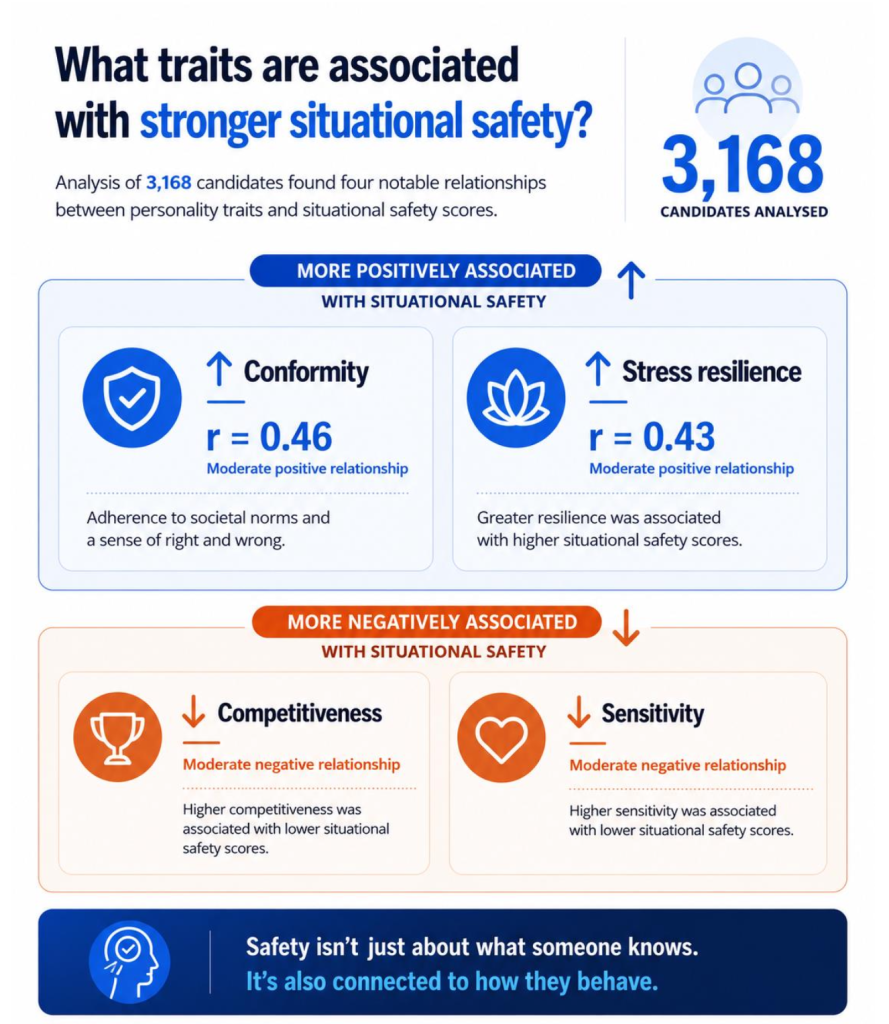
The analysis also looked at the relationship between situational safety and personality in a much larger subset of 3,168 candidates. Some of the strongest relationships were found with conformity and stress resilience.Competitiveness and sensitivity, meanwhile, showed moderate negative relationships with situational safety scores.

Interestingly, conscientiousness had only a very weak relationship with the safety measure. Research suggests that while conscientious individuals often adhere to rules and routines, situational safety involves complex factors such as attentional focus and hazard recognition. For example, studies in occupational settings show that cognitive failure, such as lapses in attention, are stronger predictors of safety incidents than personality traits like conscientiousness. This finding highlights the role of cognitive processes in accident prevention over simple personality measures.

Again, none of these characteristics should be interpreted in isolation as determining whether somebody will be safe at work. Instead the findings suggest that safety-related behaviour reflects a combination of factors.

How somebody processes information, responds to pressure, recognises hazards and approaches established rules may all contribute. This presents a more nuanced picture of safety than can be gained from assumptions, intuition or a single interview question.

WHAT DOES THIS MEAN FOR GRADUATE RECRUITMENT?

Early careers recruitment presents an unusual evidence problem. When assessing an experienced candidate, recruiters can potentially draw on years of previous roles, achievements and workplace examples. An apprentice or early career candidate may have comparatively little of that evidence available.

Yet organisations still need to make consequential decisions about who has the capabilities required for a role. This is where proxies can creep into hiring.

Experience can become a proxy for capability. Age can become a proxy for maturity. Interview confidence can become a proxy for competence. The safety data is a useful reminder of why those assumptions deserve scrutiny.

In this dataset the younger candidates did not achieve lower situational safety awareness scores, despite having fewer years workforce experience behind them. If anything, average scores were slightly higher among the younger age groups.

That doesn’t mean younger candidates are inherently safer. It does suggest however, that age and experience alone may not be reliable indicators of an individual’s safety-related judgement or awareness.

A better question is: what evidence do we actually need to determine whether this person can perform the role safely and effectively?

For some roles, that evidence might include technical knowledge. For others, cognitive aptitude, situational awareness, behavioural tendencies or the ability to remain effective under pressure may also be relevant.

The important part is establishing what matters for the role and assessing candidates against those requirements consistently.

MOVING FROM ASSUMPTIONS TO EVIDENCE

Workplace safety will always involve more than recruitment. Training, leadership, job design, organisational culture, fatigue, working conditions and the behaviour of colleagues can all affect what happens once someone enters the workplace. No recruitment process can eliminate those factors, and no assessment can determine with certainty whether an individual will experience or cause a future safety incident.

Recruitment does, however, determine who enters that environment in the first place. That makes the quality of evidence used in hiring decisions important.

For organisations recruiting apprentices and other early-career candidates, the absence of extensive work experience does not have to mean an absence of useful information. It may simply require employers to be more deliberate about the capabilities they are trying to understand and how they gather evidence about them.

The broader lesson from 10 years of safety assessment data is that assumptions and proxies often tell us less about a candidate than direct evidence of the capabilities relevant to the role. Age, experience and first impressions can all provide context, but they are not substitutes for understanding how an individual thinks, responds to risk and makes decisions.

And when the consequences of a hiring decision include workplace safety, that distinction matters.

ABOUT THE RESEARCH

This article draws on Testgrid’s analysis of more than 25,000 candidates who completed its Situational Safety Awareness (SSA) assessment as part of Australian recruitment processes between 2014 and 2024. The sample predominantly represents candidates from blue-collar and higher-risk industries, including construction and trades, mining, transport and logistics, engineering and manufacturing.

The analysis included demographic trends and, for relevant subsets of candidates, relationships between SSA scores and cognitive aptitude and personality measures. Findings are correlational and should not be interpreted as demonstrating that individual characteristics cause workplace safety outcomes.

VIEW MORE

Related Blogs

What candidates really expect from AI-assisted hiring

READ MORE

AI Hiring Compliance in Australia: Can You Defend How You Hire?

READ MORE

AI in Recruitment: Why Fairness and Transparency Matter More Than Ever

READ MORE

Why You Can’t Rely on CVs (or Referees) Anymore – And What to Use Instead

READ MORE

AI or EI? Why Human Insight Still Matters in Recruitment

READ MORE

Contact us to learn more

We're always happy to have an informal chat and share our insights on how to improve your recruitment, employee development and engagement.