Are younger workers really a greater safety risk? What 10
years of candidate data tells us
There is an understandable assumption in workplace safety: experience matters.Someone who has spent years on a construction site, in a warehouse or around heavy machinery has encountered hazards that a new entrant to the workforce simply hasn’t. They have seen what can go wrong and, ideally, learned how to respond. It would be easy, then, to assume that younger and less experienced candidates present a greater safety risk.
But when we looked at 10 years of candidate data, that assumption wasn’t reflected in the results. Testgrid analysed Situational Safety Awareness assessment data from more than 25,000 candidates who participated in recruitment processes between 2014 and 2024. The candidates predominantly came from Australian blue-collar and higher-risk industries, including construction and trades, mining, transport and logistics, engineering and manufacturing.
The analysis raises some interesting questions about how employers think about safety, particularly when recruiting graduates and other people at the beginning of their careers.
YOUNGER CANDIDATES DID NOT DEMONSTRATE LOWER SAFETY AWARENESS
The dataset included approximately 900 Baby Boomers, 4,800 Gen X candidates, 11,000 Gen Y candidates and 7,800 Gen Z candidates. Rather than safety scores declining among younger generations, the opposite pattern appeared.
Average Situational Safety Awareness scores increased across the generations, with Baby Boomers recording the lowest average score and Gen Z the highest. Statistical analysis found significant differences between the generational groups.
There is an important qualification to that finding. Average scores for every generation remained within the assessment’s “average” range.
The conclusion, therefore, isn’t that a Gen Z candidate is inherently safer than a Baby Boomer. The findings indicate differences in average situational safety awareness (SSA) scores between generations, but these results should not be interpreted as evidence that one generation is categorically safer than another, just as we shouldn’t assume an older candidate will be safer simply because they have spent longer in the workforce.
What the results challenge is the usefulness of age itself as a shortcut for assessing an individual’s potential to behave safely. is whether those assumptions are giving us useful evidence about the individual in front of us.
This is particularly relevant for early careers recruitment, where employers are often making decisions with relatively little historical information about candidates. Rather than relying on assumptions about age or experience, the evidence points to the value of assessing job-relevant capabilities directly.
SAFETY IS MORE COMPLEX THAN FOLLOWING THE RULES
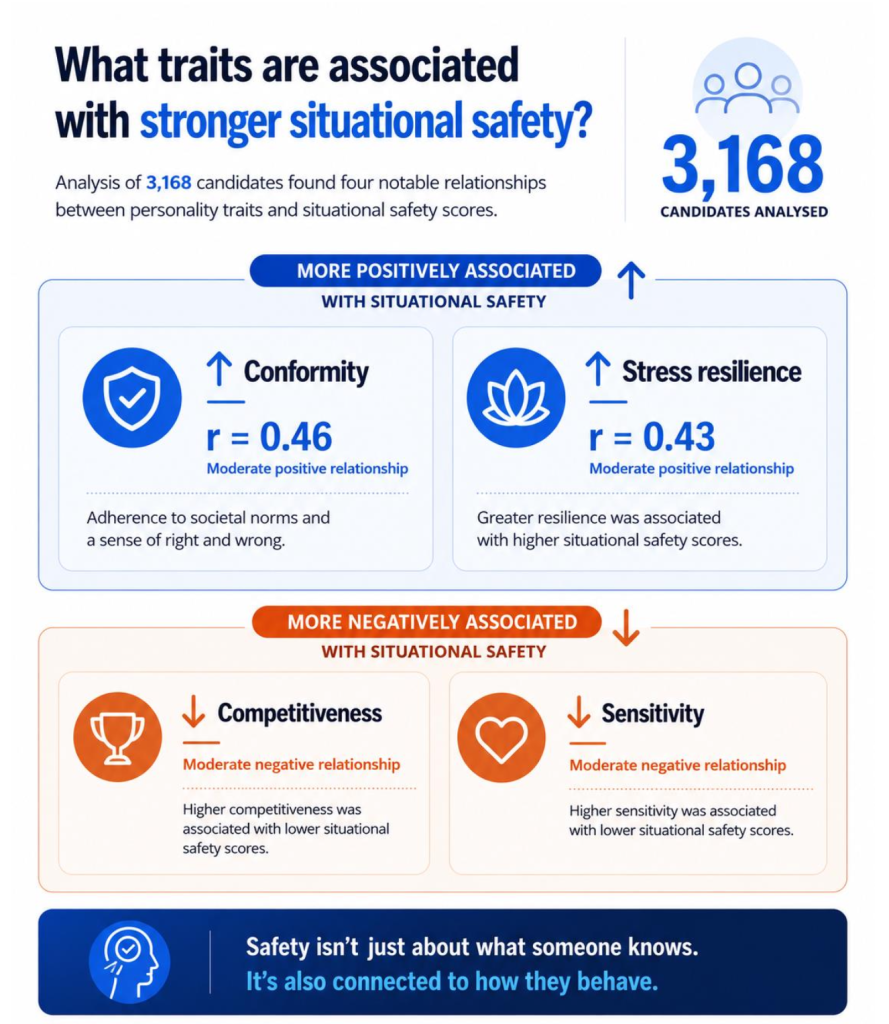
PERSONALITY TELLS ANOTHER PART OF THE STORY