Top 3 Ways To Assess Communication Skills

So, you want to assess communication skills? Start by deciding what communication means for you. Communication is a broad concept and has many levels, for example, just to name a few:

Written communication (emails, reports, proposals)

Communicating with impact (public speaking, articulating information, explaining a point: confidence and persuasiveness)

Informal communication (relating to others, building rapport, cracking a joke)

Forming connections (networking strategically and forming deep connections with others, showing understanding and empathy)

As we’re dealing with such a broad topic, if you truly want to get a thorough understanding of your candidates’ communication skills, you may want to consider the following.

Behavioural Assessment

Ever hated your job? That’s probably because it didn’t suit your behaviour. Take me for example: I. Hate. Public. Speaking. It riddles me with anxiety, my heart pounds, my hands shake and then I’m exhausted for hours afterwards from all the energy expended from my stress. Imagine if I had to do public speaking every day! I would hate my job. It wouldn’t inspire me and I’d feel unmotivated to go to work. Then I’d quit and my boss would need to find someone else. So, if you’re interviewing me for a role where I’d be presenting to large groups daily, wouldn’t you like to know this beforehand?

This is where behavioural assessments come into play. These reports show the candidate’s workplace preferences. For example, on the Saville Wave Professional Styles Assessment, there is a Competency called “Communicating Information”. This Competency refers to someone’s preference for Convincing People, Articulating Information in contexts such as public speaking and Challenging Others’ Ideas. Guess what my score was for this!

It’s important to note that this is a prediction of potential and what I prefer to do at work. I am certainly able to give a decent presentation – because I have to sometimes! I do a reasonable job, but would I like to do this every day? Hell no!

Verbal Reasoning Assessment

This same research found that although a combination of assessments and structured interviews is the leading predictor of on-the-job performance, the leading standalone predictor is cognitive ability. For jobs where communication skills are highly valued, verbal reasoning assessments are an excellent predictor of how someone may reason with, comprehend and work through problems expressed in words on the job. Skills like these are predictors of good written communication.

Structured Interviews

Comprehensive research suggests that a leading predictor of on the job performance (with a predictive validity of 0.65) is a combination of structured interviews and highly validated personality assessments. This is because personality assessments allow us to identify predicted strengths and development areas for candidates at work, and interviews help us to confirm or further investigate the results of these reports. Using multiple methods of assessment ultimately provides greater, compounded validity. This way, you get the validity and fairness of structure, alongside the human touch of a candidate face-to-face.

So what’s the perfect way to assess communication skills? Use all 3! The more information you gather, the less likely you are to make a poor hiring decision.

If you’d like more information on our range of assessments, get in touchContact Us!

Top 3 Ways To Assess Communication Skills

So, you want to assess communication skills? Start by deciding what communication means for you. Communication is a broad concept and has many levels, for example, just to name a few:

Written communication (emails, reports, proposals)

Communicating with impact (public speaking, articulating information, explaining a point: confidence and persuasiveness)

Informal communication (relating to others, building rapport, cracking a joke)

Forming connections (networking strategically and forming deep connections with others, showing understanding and empathy)

As we’re dealing with such a broad topic, if you truly want to get a thorough understanding of your candidates’ communication skills, you may want to consider the following.

Behavioural Assessment

Ever hated your job? That’s probably because it didn’t suit your behaviour. Take me for example: I. Hate. Public. Speaking. It riddles me with anxiety, my heart pounds, my hands shake and then I’m exhausted for hours afterwards from all the energy expended from my stress. Imagine if I had to do public speaking every day! I would hate my job. It wouldn’t inspire me and I’d feel unmotivated to go to work. Then I’d quit and my boss would need to find someone else. So, if you’re interviewing me for a role where I’d be presenting to large groups daily, wouldn’t you like to know this beforehand?

This is where behavioural assessments come into play. These reports show the candidate’s workplace preferences. For example, on the Saville Wave Professional Styles Assessment, there is a Competency called “Communicating Information”. This Competency refers to someone’s preference for Convincing People, Articulating Information in contexts such as public speaking and Challenging Others’ Ideas. Guess what my score was for this!

It’s important to note that this is a prediction of potential and what I prefer to do at work. I am certainly able to give a decent presentation – because I have to sometimes! I do a reasonable job, but would I like to do this every day? Hell no!

Verbal Reasoning Assessment

This same research found that although a combination of assessments and structured interviews is the leading predictor of on-the-job performance, the leading standalone predictor is cognitive ability. For jobs where communication skills are highly valued, verbal reasoning assessments are an excellent predictor of how someone may reason with, comprehend and work through problems expressed in words on the job. Skills like these are predictors of good written communication.

Structured Interviews

Comprehensive research suggests that a leading predictor of on the job performance (with a predictive validity of 0.65) is a combination of structured interviews and highly validated personality assessments. This is because personality assessments allow us to identify predicted strengths and development areas for candidates at work, and interviews help us to confirm or further investigate the results of these reports. Using multiple methods of assessment ultimately provides greater, compounded validity. This way, you get the validity and fairness of structure, alongside the human touch of a candidate face-to-face.

So what’s the perfect way to assess communication skills? Use all 3! The more information you gather, the less likely you are to make a poor hiring decision.

If you’d like more information on our range of assessments, get in touchContact Us!

Can Skills Assessments Mean Death to the Resume?

Assessing for Skills and Growth Potential.

We recently attended Talent Table’s Talentpalooza, where  Bas van de Haterd gave a compelling talk that mentioned the irradiation of the resume in the pursuit of removing bias from the recruitment process and how utilising screening tools is crucial to achieving this. In addition to removing bias, removing the need for a resume allows hiring managers to focus on candidates’ ability to perform well in a role (with the right tools of course).

In Bas van de Haterd’s words: “A resume tells me what you have done, for who and for how long. Not how well“.

But how can you determine how well a candidate will perform in a role ahead of time? This article will look at some of the pressure the current low unemployment rate is putting on Australian organisations and share some tactics you can use to look beyond the resume.

The Skills Shortage isn’t Going Away Any Time Soon.

The Australian Financial Review recently broke the news that although 159,500 international students, skilled workers, and tourists arrived in Australia in February, the skills shortage in Australia is not being resolved any time soon. Hiring managers are having to cut down job ads and let previously key criteria slide down the priority list. In fact, a recent survey of 300 hiring managers at the end of last year, found that 84% were willing to compromise on key criteria.

The most popular criteria among these criteria were:

– Education qualifications
– Technical certifications
– Years of experience

So with these criteria out of the running, how are businesses recruiting? Firstly, these criteria slipping is not the worst thing in the world. Why? Because they are not indicators of on-the-job performance. To quote Organisational Psychologist and Member of our Advisory Board, Dina Ward:

“This is the biggest challenge I put to organisations: ‘your job ad says five years experience in industry X. Why?’ That five years’ experience may not have led to their developing more skills or insights. Yet someone with two years experience may have grown and developed in meaningful ways.”

Evaluating on-the-job performance takes more than looking at qualifications or years of experience. It’s a mixture of elements that can be identified ahead of the interview with some simple steps.

Let’s take a look at a live example.  

We currently have a Sales Operations role live. We know that as you read this article, the unemployment rate is 4% in Australia (expected to be 3.35% later in the year). We know that we may get fewer candidates applying for this role than normal and that the candidate pool will be more varied than usual. The applications will be mixed in previous experience and industry while boasting transferable skills that may allow them to thrive in the role.

So how will we be approaching filling this role? Let’s split this into 2 simplified methods (we will go into more detail during our upcoming webinar).

1. Hiring for culture add with behavioural assessments
2. Hiring for on-the-job performance with cognitive and skills assessments

In the first process, we can determine whether candidates may add to Testgrid’s culture by ensuring they have the appropriate behavioral traits to succeed in the role.

In the second, we can predict on-the-job performance by assessing applicants’ skills and cognitive ability to perform the role. Take Excel for instance; the role is data-heavy, so this is a crucial hard skill that candidates must bring to the role. As a result, we won’t be knocking back anyone because they don’t have 5 years of sales experience if they show the ability to perform such a crucial part of the role and have the cognitive ability to learn as they go..

So where does that leave resumes? 

We aren’t the first to say it but relying, particularly solely, on resumes should be a big no-no in your organisation. A quote from ERE Media’s blog WAY back in 2012 summarises the challenges with resumes perfectly:  “Resumes are, at best, self-reported descriptions of historical events.” and that “Resumes frequently contain untruths and half-truths…as many as 80% of resumes contain misleading statements. And on average, 53% contain actual lies.”

10 years later the “upload your resume” button is all too prominent on job ads, so for now, the old-fashioned way seems to be the preferred method for some. But in an increasingly competitive job market, where the cost of staff turnover continues to rise, can you really afford to take the chance by not focussing on the requirements of your role and assessing your candidates’ on-the-job performance.

If you would like to learn more about how you can implement skills-based hiring into your process, check out our recent guide on Skills-Based Hiring here.

Register for our Upcoming Webinar on Validating on-the-Job Performance

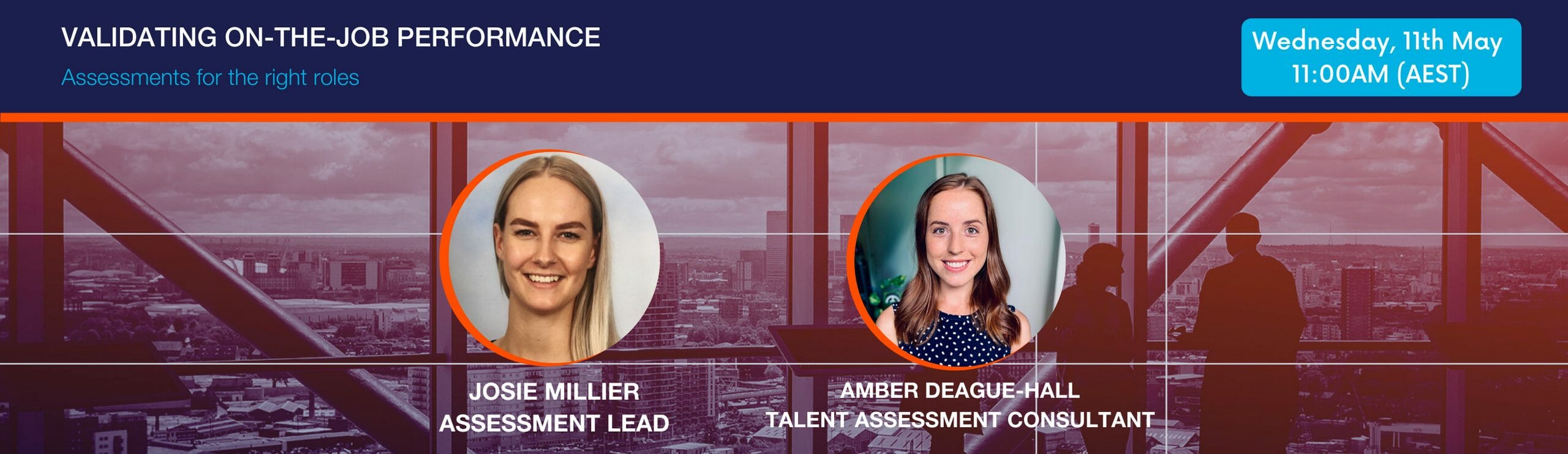
You can learn more about skills-based hiring and assessing on-the-job performance in our upcoming webinar with our Assessment Lead, Josie Miller who will be joined by Testgrid’s Talent Assessment Consultant, Amber Deague-Hall, where they will be discussing how organisations are using skills assessments to predict on-the-job performance and just why the method is critical in today’s market.

upcoming webinar banner

How Committed to Diversity are Australian Organisations, really?

A look at how many Australian businesses are tracking the success of their D&I goals.

Promoting a diversity and inclusion culture is one of the key goals set for HR departments and business leaders. Many organisations state they strive towards this goal, and many do, but how important is diversity and inclusion to organisations overall objectives really?

How do organisations hold themselves accountable and put their money where their mouth is when it comes to championing diversity and inclusion? How many say they strive towards inclusivity but have no tools or processes in place to back up such a claim? How many just don’t bother at all?  In this article, we will look at the data surrounding these factors to understand how investment in diversity and inclusion is progressing.

Setting and Achieving Diversity and Inclusion Goals

When we want to achieve a goal in our organisation, we take a strategic planning or project management approach by creating a strategy with actions that edge us ever closer towards achieving that goal. Your Diversity and Inclusion goals are no different and should be treated the same as any other commercial objective if they are to be achieved. Many organisations start out well with their Diversity and Inclusion initiatives, but a vast number of these initiatives prove ineffective or fail within a year or two. Why? The details and depth of strategic thinking behind them is as thin as the paper they are printed on.

This is unsurprising when you consider that most diversity and inclusion initiatives are developed to comply with corporate governance and self-regulation.  For example, in many workplaces, these initiatives are usually poorly funded tactical inclusion initiatives disconnected from broader, more substantial, and well-funded general training programs. They may be well-meaning, but they are misguided in their approaches.

In ELMOS’s 2022 HR Industry Benchmark Survey, when respondents were asked, what metrics are used to measure success? Over 35% of HR professionals stated that engagement and retention were the top metrics, whereas only 14% stated diversity and inclusion targets as success metrics. If only they knew that diverse and inclusive organisations work 12% harder, are 19% more likely to stay longer with the organization, and collaborate 57% more effectively with peers.


Source: ELMOS Benchmarking Report

That leaves 86% of organisations not using diversity and inclusion as a success metric, so how can organisations truly promote a D&I culture if such a large majority don’t measure it at all? diversity and inclusion is far more than an “HR issue.” It should be a core ingredient in the design and execution of business strategy and embedded in the activities of the organisation day in, day out.

The key to driving results in workplace diversity lies in uncovering your employees’ passion points, channeling initial efforts toward those, and setting attainable diversity goals to match.

Take inspiration from the circumstances unique to your organisations. What is most relevant to your team may vary depending on your company size and industry, and factors that inflect diversity – like specific departments, seniority, and type of diversity (gender, ethnicity, background, disabilities, and more).

How To Track Diversity and Inclusion Success

“What gets measured, gets done” is particularly relevant for diversity and inclusion, because the biases that perpetuate workplace inequality are largely unconscious and automatic. Metrics help employers committed to diversity and inclusion stay on track by encouraging the identification and management of bias blindspots—mindsets and practices that promote homogeneity but which are largely hidden.

There is no standard or universal set of metrics to measure diversity and inclusion. Each company should take a personalised approach to decide which metrics they want to measure.  The best, most effective diversity and inclusion metrics will be a blended approach that starts with representation measures — who have you hired, retained, and promoted — and adds data that provides insights into how inclusive the company culture is.

For example you might track:

  • The diversity of employees v the diversity of your talent pool
  • The diversity across organisation levels
  • Job satisfaction and Job retention

Consider softer, non-obvious measures such as:

  • Who is and isn’t talking in group meetings
  • Who is and isn’t taking part in non-compulsory activities (team lunches, games)
  • Males taking parental leave

Top Challenges for HR in 2022

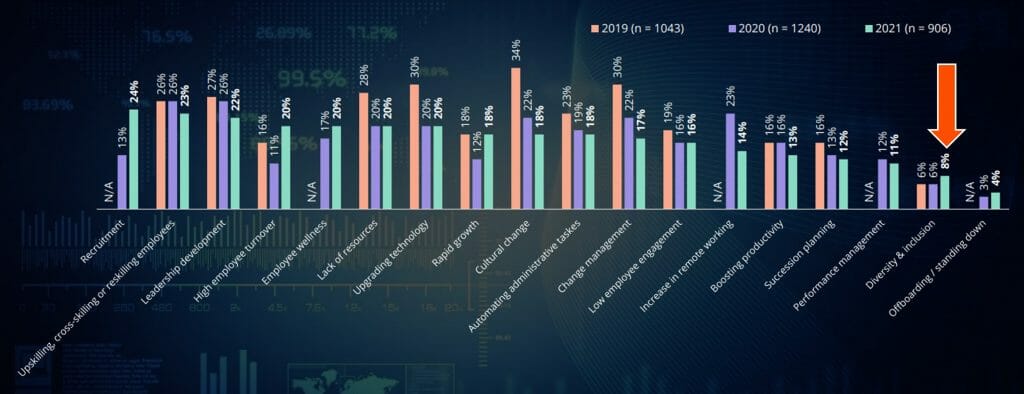
When ELMOS’s survey asked what the top challenges for organisations will be in the next 12 months, only 8% of them stated that diversity and inclusion will be a challenge in 2022. We must ask what this means? Are organisations doing D&I so well that they don’t foresee any challenges or are they just blind to the challenge? The abovementioned 86% of organisations not using diversity and inclusion as a success metric would suggest the latter.

2022 Challenges:

diversity and inclusion HR objectives

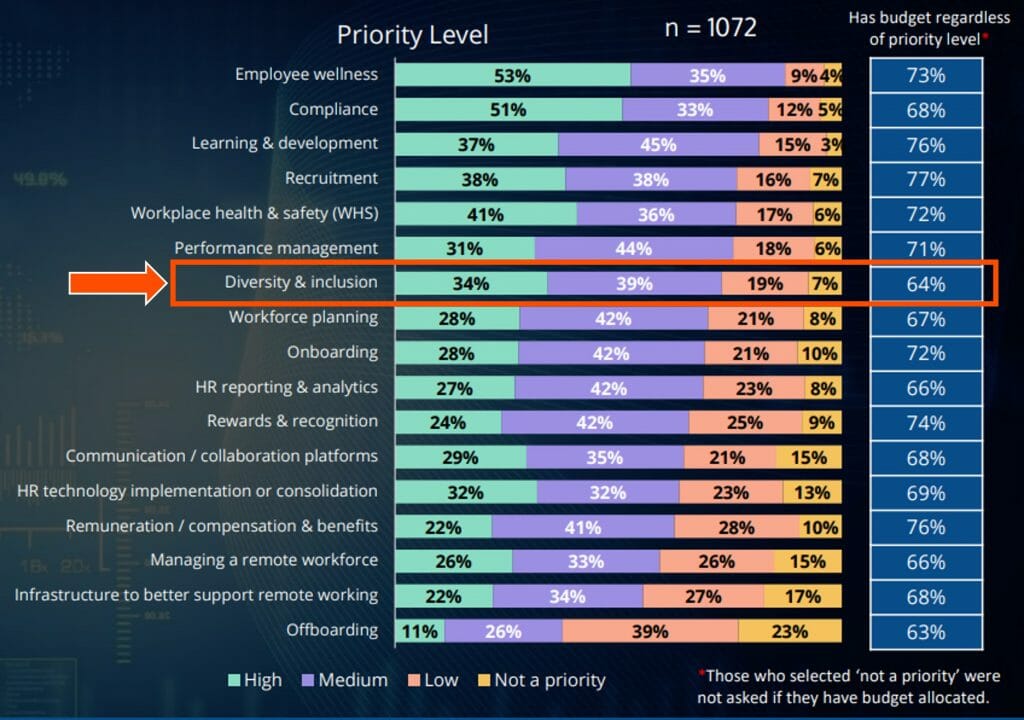
When the survey asked about where diversity and inclusion sits in their list of priorities, 34% of respondents stated high (up from 31% in 2021) and 39% stated medium priority (up from 37% from 2021). When the survey asked about where diversity and inclusion sits in their list of priorities in terms of budget allocation, 34% stated high with 39% stating D&I as a medium priority.

Diversity and inclusion KPIs

In total that makes 64% of organisations dedicating budget to diversity and inclusion initiatives or technology in 2022. This is a positive sign, as although 86% are not setting KPIs for their D&I activity, the report shows that these 64% are investing in diversity and inclusion, either to continue or start their journey towards an inclusive and equal workplace.

Costs of Poor D&I

We must, however, call upon the remaining 26% (the 19% that stated low and the 7% that stated D&I as not a priority) that are trailing behind to review the benefits of diverse and inclusive workplace for their business (view guide here). We have provided a few below:

  • 67% of job seekers say diverse workforce is important when considering job offers (Glassdoor).
  • Organizations that prioritize diversity and inclusion are 35% more likely to have better financial returns than companies that don’t (McKinsey & Co.)
  • Additionally, a study by Deloitte found that diversity and inclusion in the workplace can boost innovation by as much as 20%.
  • Diversifying your team can help boost productivity by 35% (McKinsey & Co.)

D&I is an important factor for many of today’s job seekers, 70% of whom say. You can learn more about the benefits of improving your organisation’s D&I and how to roll out a strategy in our Guide to Diversity and Inclusion: Starting Out On The Journey eBook.

Now is not the time to be losing employees or candidates to lack of diversity

We are approaching a quarter of the way through 2022 (I know right?), Australian unemployment is currently sitting at 4% (the lowest it has been since the financial crisis in 2008), which means the job market is more competitive than it has been in the last decade.

The current cost to fill a vacant position is up 127% on the previous year and the number of days to fill a position has increased by 21% to 40 days.

diversity and inclusion cost to fill a position

2021 data shows that it can cost up to 33% of an employee’s salary to replace them and based on current average salary data that equates to an average cost of $19,000.

You can learn more about the cost of low engagement and replacing staff by downloading our Finding and Keeping Engaged Employees eBook.

Get in Touch

If you want to talk to one of our experts about how we can help drive your success with the right people, we are offering a gap analysis with on of our expert team. Simply sign up and book a time or contact hello@testgrid.com.

You can learn more about the importance of Diversity and Inclusion in Part 1 of our D+I Ebook series.

3 Leadership Challenges to Act on Now

Strong, empathetic and effective leadership has never been more important.

This year has brought with it a whole plethora of leadership challenges for businesses. I mean, where to begin at this point but let’s have a look.

First, we have the great resignation, with employees coming out of lockdown(s) now fleeing their employers in droves to move to organisations that are more in line with their needs/beliefs or due to how they were treated during multiple lockdowns or to pursue a whole new career or even go freelance.

Then we have the skills gap, as a result of border closures and other pandemic-related mayhem. PWC recently reported that 75% of Australia’s CEOs (and 79% globally) are concerned about the availability of key skills and many other sources cite the skills shortage as a key problem.

Then there is the increasing competition for talent, as a result of the above. Many organisations are bending over backwards to provide candidates with attractive packages that include sign-on bonuses, flexible working and development programs.

We know that employee engagement is now more crucial than ever before and our customers tell us that now is not the time organisations want to be losing top talent as a result of lack of engagement or sub-par leadership.

Key Leadership Challenges

We have spoken to our customers and surveyed the feedback from organisations across multiple sectors to uncover the top challenges they are facing when it comes to leadership and navigating these issues. Below are the top 3 challenges facing leaders.

1. Talent acquisition, retention, and re/upskilling Leadership Challenges

KPMG’s recent “Keeping us up at Night” survey cited that 69% of HR professionals stated that this is a major concern for them this year and given the competitive nature of the job market, we understand why.

Our recent “Finding and Keeping Engaged” employees series shows that it costs on average 33% of employee’s salary to replace them should they leave and according to the Australian Bureau of Statistics, 31% of workers are planning on moving on from their organisation this year.

2. Managing Remote Working & Return to Work Leadership Challenges

This is a crucial challenge many businesses are now navigating. With varying rules/guidelines across Australia regarding where employees should be working now that we are through the brunt of the pandemic, many organisations are trying to implement the best strategy for their business, while managing the needs of their employees.

Many employees have simply adjusted to working from home and the benefits that come with this. From work style preferences to being closer to family to no longer having to plan for the long work commute, it’s difficult to get staff back in the office, particularly when the competition offers flexible working.

Check out our recent blog on managing virtual teams, where we looked at how leaders can utilise not only digital platforms but leadership tactics that allow managers to get the most out of their staff while ensuring employee engagement.

We also have highlighted a range of Return to Work tools you can use to introduce employees back into the office.

3. Developing Leaders

The CEO Leadership Report surveyed over 360 CEOs and more than 2,000 HR professionals found that just 38% of them deemed their mid-management leaders to be “very good” or “excellent”. This suggests that organisations are failing to develop middle-management to eventually take on C-Suite positions.

This year it is crucial that organisations train their leadership team to better manage their direct reports and to provide the skills they need to lead and therefore be considered for roles within the C-Suite.

This training must focus on training leaders to adapt to an ever-changing landscape in real-time, as well as develop empathy and an emotional connection with their teams to reduce flight risks.

You can view our leadership development packages here to find out how Testgrid can help you tackle these challenges.

Why Organisations Can No Longer Avoid The Benefits of Psychometric Testing

More and more businesses and government institutions are reaping the long-standing financial and non-financial benefits associated with psychometric testing.

We’re well into 2022, and the need to assess whether candidates are the right fit for a job is becoming more prevalent than ever. From a procurement, recruitment, talent acquisition, succession planning, or HR point of view, whichever way you look at it, psychometric testing can no longer be avoided.

The personality, behavioural traits, and competence of a candidate can be very difficult to ascertain during an interview. An interview process can be fairly subjective and although employers normally assess skills and experience very accurately, too much is left to first impressions and gut feel regarding aligned values.

This is precisely why psychometric assessments have such an important role to play in the recruitment process. Not only do they provide an objective view of one’s strengths and development areas but they also quantify a person’s current and potential skills and capabilities. All of this can be aligned to job requirements and organisational strategies.

The list of benefits is quickly becoming endless. From protecting organisations from the cost of a wrong hire to saving recruiters time and leading to better quality candidates.

Psychometric Testing Benefits

For employers, psychometric testing could help to employ job applicants with high levels of integrity, predict future performance of a candidate and improve employee retention by successful hiring decisions.

Assessments can also have further measurable return on investment. Once a candidate is selected, assessment results can be put to further use. Example: Personal development plans can be implemented, knowing who employees are and what motivates them. Results can also inform training requirements that are specific to individual needs, thereby assisting in optimising learning and development strategies.

The companies that have incorporated psychometric and competency-based assessments into their recruitment process have seen great improvements in their recruitment decisions. If you’re interested to learn how Testgrid could help in your organisations, talk to us today!

Hiring for Culture ADD, not Culture Fit

You may have heard ‘culture add’ being thrown around as a bit of a buzzword in recent months – but what does it actually mean, and how do we put it into practice?

In a nutshell, culture add means seeking candidates who can add something different to your team, or bring a fresh perspective. It says, “yes, there are certain skills or attributes that we can’t compromise on for this role, but aside from these – we’re looking for individuals who can bring something new or different to the table.” Hiring for culture add demonstrates that you value diversity. Unfortunately, while ‘culture fit’ probably had good intentions originally (hiring people who will thrive in your specific organisation), it has become more and more dubious as a rationale for recruitment decisions.

“I’m just not sure that she’d fit in here.”

“He’s super qualified, but would I really want to have a beer with him after work?”

“My gut is telling me that she’s just not like us.”

Any of these sound familiar?

The Warning Signs

All of these are clear warning signs shouting “unconscious bias is at play here!” ‘Culture fit’ can be a vague, ill-defined term used to reject candidates who don’t fit the mould. It can mean hiring a bunch of people who think and behave the same way as you do.

If we always hire candidates who feel ‘safe’, ‘familiar’, and ‘like us’, sure – we might make some new friends. But we’re also much more likely to fall victim to ‘groupthink’: where harmony within the group is prioritised at the expense of creativity or unique thinking. Teams are particularly vulnerable to groupthink when its members are ‘similar’. It might feel comfortable to work in an environment where everyone thinks in the same way, but it’s certainly not conducive to change or innovation. A Stanford University study found that while firms who hired for ‘culture fit’ were less likely to fail (than those who didn’t), they also grew at the slowest rate, relative to other firms. Scholar Adam Grant explained this phenomenon as “what got you there doesn’t get you here. Culture fit might be good early, but dangerous late.”

Be open to something different

We encourage you to carefully consider what your ‘non-negotiables’ are when you hire staff. Like Facebook and Atlassian, it might be your organisational values. It might be a specific behavioural preference, like adaptability or customer focus. It might be having a strong work ethic. This will look different for every organisation. Where you can, use objective methods (such as psychometric assessment) to measure these things. And then, aside from your non-negotiables, be open-minded and consider candidates with qualities or experiences that will help your organisation grow. I heard this posed recently as: “Look for someone who can be your counterpart, rather than a reflection”. Your organisational culture should not be static; it should change with each new person that joins the team.

At Testgrid, we recently held a Hackathon and broke up our usual working teams so that we’d all have the opportunity to brainstorm with other staff that we don’t work with on a day-to-day basis. As part of the Psychology team, I was assigned to a Project Team with staff from Sales and IT Development, which was fantastic. And without tooting my own horn too much – we all came up with some pretty great ideas!

Culture Add Tips To Get You Started

Keep your interviews structured, with standardised questions. Having lengthy unstructured conversations with candidates can increase the risk of affinity bias – as you may discuss commonalities such as kids, sporting interests, which university they attended, and so on.

Consider what qualities don’t yet exist in your team. How can you make your team even stronger? In interviews, ask your candidates: “What can you add or bring to our organisation, in terms of something different?”

Atlassian’s Global Head of Diversity & Belonging, Aubrey Blanche, suggests probing colleagues further when they use the term ‘culture fit’ in a hiring process, by asking: ‘What do you specifically mean by that?’ This can open up valuable discussion around specific attributes being sought, and can minimise the influence of unconscious bias.


5 Key Recruitment Trends and Changes

The recruitment trends landscape has been in a constant state of disruption for over 2 years now but it hasn’t all been bad. Anomalies as results of Covid-19, such as lockdowns “The Great Resignation” and “The Great Exhaustion” have all brought challenges but for many industries, they have also brought opportunities. Some Recruitment trends and challenges will continue into the mid 2020’s, such as the ongoing skills shortage and managing the demand for flexible work but recruiters and HR departments have been kept busy with talent within Australia’s borders.

The past 3 years have required organisations to adapt more than ever to find and attract top talent. With travel restrictions a thing of the past and the governments latest announcement, we can’t expect an influx of overseas talent in the next 2 years, but that doesn’t mean all will be quiet.

With the power still sitting with employees and candidates, people are moving around and looking for opportunities at an increased rate. Now is the perfect time for Australian businesses to streamline their recruitment funnel and ensure they are attracting the right talent with the right skills and behavioural preferences of their businesses.

In the first part of our recruitment trends series, we have looked at the top 5 challenges and recruitment trends facing organisations in the coming months.

Neurodivergent Candidates Recruitment trends

Organisations are doing more and more to ensure their processes are fair and inclusive for neurodivergent people. New assessments and technology are empowering businesses to move away from obsolete practices that push neurodivergent candidates out of the funnel.

Neurodivergent candidates have a range of skillsets they can bring to organisations and excel in a number of areas beyond those that are not neurodivergent.
There are 3 million neurodivergent people in Australia and this largely untapped talent pool can help ease Australia’s skills gap. Just some of the unique skills neurodivergent candidates can possess are:

  • Sustained concentration
  • Faster problem solving
  • Superior memory
  • Strong attention to detail
  • High integrity

Watch our webinar with our partner Xceptional on developing a neurodiversity-friendly business environment by equipping your hiring managers and teams with the knowledge and tools to source, recruit and work with neurodiverse colleagues.

Flexible Working is Here to Stay

Many organisations now include a flexible working arrangement as part of their offer and several organisations have negotiated with their staff to work from home on certain days to maintain employee engagement.

A survey by Hays in December 2021 asked 4,007 respondents what flexible working means to them. 59% defined a flexible model as working from home regularly at any time. Most people feel flexible working should not include a fixed schedule and instead use a model that is based on shifting business and individual priorities. 35% stated that flexible working looks like a hybrid working on a set schedule, proving that some professionals are agreeable to a prescribed on-premises and remote roster.

This year businesses need to move towards a hybrid model and be cognisant of what competitors are offering talent and be prepared to lose candidates if your flexible model isn’t competitive. As Australian businesses advance forward with their chosen models it is now imperative to understand how elements such as culture, collaboration and community can be instilled and nurtured using a flexible model.

Environmental, Social and Governance (ESG)

Environmental, Social and Governance (ESG) alignment has become a crucial component for candidates. ESG includes an organisation’s environmental impact, social impact, mental health and wellbeing support and equity, diversity and inclusion policies.

Our recent webinar on Employee Engagement touched how candidates want to work in organisations that align with their values and if the Great Resignation has taught us anything, it’s that people want to work for organisations that care about their wellbeing.

Diversity and Inclusion continues to grow in importance, as people want to work in diverse environments and for organisations that offer opportunities to diverse people.

Digital transformation & optimisation and extracting organisational value from it

Digital transformation is the number one issue facing Australian business leaders in 2020, has remained a core concern in 2022, but with a twist. Two years ago, digital transformation risk was primarily about implementation; enabling IT to deliver much-awaited productivity gains and engender workplace flexibility. Today, the risk associated with digital transformation has moved into a different phase as many organisations have been forced to embrace new technologies and ways of working to navigate COVID‑19. The risk today is more about optimising outcomes and extracting organisational value from change that has already occurred.

Our recent A.I webinar touches on this by looking at the contrast between the technology organisations have been sold vs what has actually been delivered and what organisations are getting out of their technology.

Skills Shortage Continues

This month’s mid-year economic and fiscal outlook update shows net overseas migration is set to dramatically turnaround in coming years. From minus 72,000 in 2020-21 and minus 41,000 in 2021-22, it will lift to 180,000 in 2022-23.

In May, the federal government was predicting net migration would be about half this in 2022-23. This month, the federal Treasurer said the increase “includes about 200,000 places for students, tourists and skilled workers to address skills shortages”.

However, with concerns around Covid-19 still looming the opening of borders is not set to be an immediate solution to the labour market skills shortage. Given record vacancy activity, internal and external migration will balance out the exodus of young workers who embark on their postponed overseas work experience, diminishing hopes that immigration will ease existing skills shortages in some industries.

Organisations must improve their processes to identify and hire (and retain) the right people, source talent from overseas and increase graduate recruitment to tackle the ongoing skills shortage. Watch our graduate recruitment trends webinar here to learn about graduate recruitment trends and challenges.

Is Cognitive Testing Culturally Biased? How To Use It In a Diversity-Centric Manner

We recently came across a Canadian cognitive aptitude testing study published this year by Hausdorf and Robie, which explored differences in general mental ability (GMA) test scores among culturally diverse groups in the context of employment selection. This paper explored whether using GMA tests in recruitment can result in adverse impact upon cultural minority groups. For context: this study specifically examined GMA testing scores for immigrant versus non-immigrant applicants for a bus driver position.

Applicants completed a short pen-and-paper cognitive aptitude testing GMA test. The authors’ hypothesis: that first-generation immigrant applicants would score lower on the GMA test than other applicants (second-generation immigrants or non-immigrants), was supported. However, cultural differences in GMA scores were largely eliminated after controlling for variables like age, years of education, and English fluency.

An earlier study by the same authors used data from a number of countries including Australia, and found that cultural differences in GMA testing scores in Australia were “small to non-existent”. The authors also found in this sample that second-generation immigrants’ GMA testing scores were higher than non-immigrants’ scores. Importantly, in this study, the authors noted:

It is important to recognise that we are not implying that current GMA tests are predictively biased against immigrants to any significant degree. Eliminating the use of GMA tests in personnel selection will likely reduce the overall validity and utility of a selection system. Moreover, relying [solely] on interviews has its own problems

What can we learn from this cognitive aptitude testing, and how can we ensure that we administer cognitive testing in a culturally sensitive manner?

Language availability

In this study, the test was administered in English, however – 79% of applicants (most of the sample) identified as first or second-generation immigrants, and consequently may have learned English as a second language. Some online GMA tests are available in a range of different languages: the Saville Swift Analysis Aptitude – Rx, for example, is currently available in 29 languages! Checking language availability of cognitive aptitude testing may be worthwhile, particularly if you are administering assessments internationally.

English as a Second Language (ESL) norm groups

If your chosen cognitive assessment is only available in English (which can be the case), Testgrid strongly recommends considering using an ESL norm group. When using cognitive aptitude testing for recruitment, we are most interested in how the candidate has performed relative to others: for instance, relative to other graduates, or to other professionals and managers. When examining cognitive testing results, it is best practice to compare an individual to others who are most similar to them. (This also makes logical sense: for example, we wouldn’t really be interested in how an electrical apprentice candidate has performed compared to HR managers! We would be most curious about where their results sit compared to other apprentices.) In the case of individuals who have learned English as a Second Language: research suggests that compared to the general population (on GMA tests administered in English), ESL candidates tend to perform slightly less well on the Verbal Reasoning component and that there is generally no difference for Numerical or Abstract Reasoning components. Again, this makes sense as Verbal Reasoning items often involve vocabulary, grammar, analogies, and reading comprehension. For an individual reading such items in their second language, they may still answer correctly, but may just take a little longer to read through or analyse the items. Consequently, we believe the fairest and most diversity-centric approach is to use ESL norms where possible. Testgrid has created ESL norms for a number of our cognitive assessments.

Abstract Reasoning

Abstract Reasoning cognitive aptitude testing is becoming more popular as diversity-centric cognitive tests, as they are language-free (and acultural), and therefore cannot discriminate on the basis of English language. Rather, these visual items involve shapes and patterns and provide an important measure of fluid reasoning: how we solve new problems and reason in a logical manner. Performance on these tests is also less affected by socio-economic factors and educational circumstances.

To speak with us about diversity-centric cognitive testing, please get in touch with us at here!

How to Embrace Neurodiversity in Your Workplace

Neurodiversity is “the diversity of human brains and minds”

Neurodiversity is a term originally coined by Australian sociologist, Judy Singer, in the late-1990s. It refers to the range of differences in individual brain function and behavioural traits, regarded as part of normal variation in the human population (used especially in the context of autistic spectrum disorders). In the workplace, it is the idea of inclusivity that extends to neurological differences, including hiring and retaining talent with neuro-variations such as autism, ADHD, and dyslexia.

Despite increased awareness of neurodiversity, the latest data shows that Australia experiences one of the highest rates of unemployment of people with disabilities in the OECD (Soldatic & Pini, 2009), suggesting a lack of sustainable employment opportunities for people with disabilities (Lantz & Marston, 2012). Compound this with the fact that many standard recruitment practices (such as the use of technology to assess social skills) can disadvantage neurodiverse candidates and you’ve got a roadblock.

Neurodiverse candidates often possess exceptional skill sets, such as being able to recognise patterns within large sets of data and prolonged periods of concentration, that other candidates may not, yet those affected often struggle to fit the profiles sought by prospective employers. Multiple studies have shown that there are also correlations between elevated levels of stress caused by uncertainty for those diagnosed with Autism Spectrum Disorder (ASD). Therefore, when it comes to recruitment, neurodiverse candidates will benefit from knowing exactly what to expect at each stage of the process.

In 2016, EY piloted an Autism program in Philadelphia, hiring four people with autism as account support professionals. The program established EY’s Neurodiversity Center of Excellence, which today employs about 60 people across the U.S. and is looking to expand internationally.

According to Harvard Business Review, the benefits of neurodiversity programs include “productivity gains, quality improvement, boosts in innovative capabilities” (because neurodiverse employees often do not see things the same way neurotypical employees do) and “broad increases in employee engagement.”

So let’s take a look at how you can attract and retain neurodiverse talent.

Remove barriers from your application process

We’ve said it before as it really is an outdated practice, but generic blanket statements on job descriptions only muddle otherwise straightforward insights and make job functions unclear, especially for neurodiverse applicants. Simplify your language and make it specific to the job you are posting. Creating a job description can be tough, but investing the time it takes to write a good one improves not only the volume of candidates, but the diversity and quality of those candidates.

Our experience tells us that job adverts often include lengthy ‘wish lists’ of essential skills, so we recommend challenging these – do all employees really need “excellent communication skills” for example (often a default skill listed), as neurodiverse candidates may be dissuaded from applying.

Clarify that your company welcomes neurodiverse candidates

Make this small addition in the introduction of your job ad. It puts neurodiverse candidates at ease and helps them feel confident in submitting their application. For example, you could say something like:

“[Company name] welcomes applications from neurodiverse candidates, and is willing to make accommodations in the interview process to best suit the needs and strengths of the individual. If you require accommodations, please contact us upon our response to your application”

Set candidates expectations

The traditional recruitment process can make  candidates with neurodiversity nervous due to the uncertainty of the process or expectations, combined with the knowledge that their every action is scrutinised. Successful applicants should be provided detail in a clear format in advance that outlines the recruitment process, such as what to expect on the day, directions to the office, and names of the hiring managers who will be interviewing them. This kind of pre-planning is just one change that employers can make to enable neurodiverse candidates to perform at their best.

Rethink the interview process

Another factor preventing this untapped talent pool from being hired is that many hiring managers don’t know how to interview someone on the autism spectrum, who might not perform well in a traditional sit-down interview. Traditionally, the interview process has relied heavily on social cues such as body language, eye contact and communication skills. However, during the interview itself, interviewers should focus on the specific skills needed for the job. In this case, it is best practice to allow neurodiverse candidates to see questions in advance of the interview.

Audit your assessments

Assessment technology is increasingly used to level the playing field and encourage meritocratic hiring, however, some approaches can disadvantage neurodiverse candidates. For example, some game-based assessments can include elements of pattern recognition which has a disproportionate impact on neurodiverse candidates.

When assessing neurodiverse candidates, hiring managers should consider the type of environment that this will be taking place in. For example, neurodiverse individuals may have a heightened reaction to external stimuli such as noise, so it is worth producing an interview guide that encourages candidates to select an area that will be free of disturbances (if undertaking assessments remotely).

In Summary

Creating a neurodiverse workforce will require hiring managers to take a step back, remove assumptions and communicate in a new way. The bottom line is that inclusion is worth the extra effort.

Contact us to learn more about the challenges of recruiting neurodiverse candidates and how we can help you adjust your recruitment process.